Nine documented biological mechanisms drive hair loss. Standard prescriptions address one or two. This topical botanical oil is built around published research — including trials where rosemary and peppermint oil matched or outperformed minoxidil.
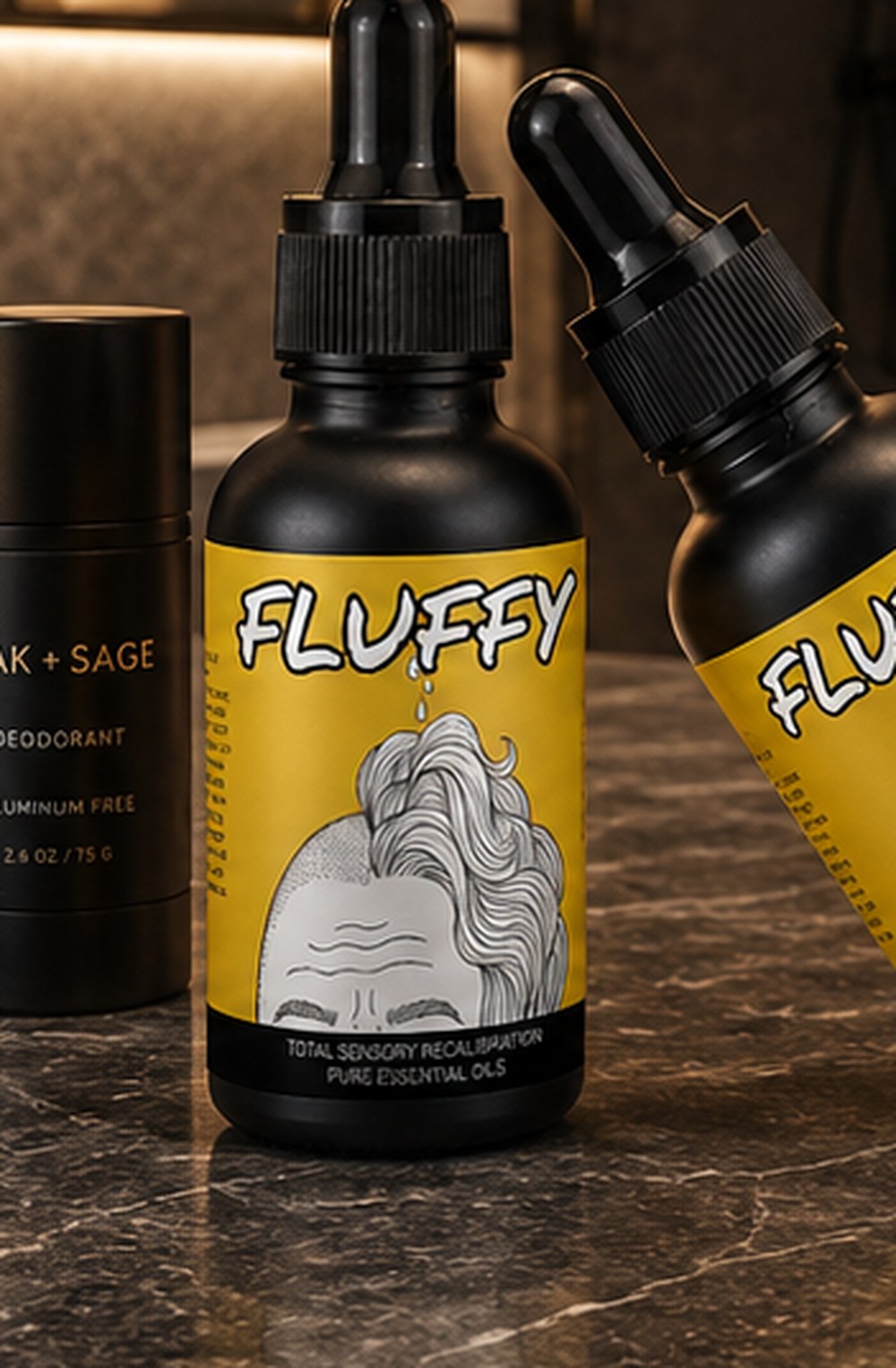
Nine biological mechanisms are documented to drive hair loss. Standard prescriptions address one, maybe two. FLUFFY is a topical botanical oil built to address all nine at once — formulated and tested by Dr. Troy Delane Frazier, DC on himself, after his own specialists dismissed his hair loss as simply genetic.
You walked in. You got a prescription for one hormone and a bill every month for the rest of your life. Nine biological mechanisms are documented to shrink follicles. The leading pharmaceutical treatment addresses one of them.
DHT is real. It does drive hair loss. It is also one of nine published mechanisms, not the whole picture — and the industry built an entire market around suppressing it forever rather than addressing what else is happening.
| Mechanism | What It Does |
|---|---|
| 1. DHT Conversion | 5-alpha reductase converts testosterone into DHT, which binds androgen receptors in the dermal papilla and progressively miniaturizes the follicle. The one mechanism pharmaceuticals address. |
| 2. PGD2 Signaling | Prostaglandin D2 runs three times higher in balding scalp tissue and sends a direct miniaturization signal, completely independent of DHT. A 2012 Science Translational Medicine study established this. Zero FDA-approved hair loss drugs address it. |
| 3. Reduced Scalp Blood Supply | The follicle needs continuous oxygen and nutrient delivery. Chronic tension, fibrosis, or medication side effects reduce flow, shortening the growth phase and increasing shedding. |
| 4. Scalp Microbiome Disruption | Malassezia, a fungal organism feeding on sebum, creates chronic low-grade inflammation when it overgrows and amplifies DHT sensitivity at the follicle opening. No pharmaceutical product addresses this. |
| 5. Cytokine and Neurogenic Inflammation | Inflammatory cytokines from illness, stress, or gut dysfunction reach the follicle through circulation and disrupt the growth cycle directly — why major illness, COVID infections, and significant stress reliably trigger diffuse shedding two to three months later. |
| 6. Endocannabinoid System Dysregulation | CB1, CB2, and TRPV1 receptors in the follicle regulate the growth cycle. When dysregulated, follicles exit growth phase prematurely. Zero pharmaceutical hair products engage this system. |
| 7. Oxidative Follicle Damage | Hydrogen peroxide accumulates in aging follicles, damaging both hair- and pigment-producing cells — driving graying as much as thinning. Copper-dependent enzymes are the primary defense; copper deficiency removes it. |
| 8. Sebum Dysregulation | DHT drives excess oil production, which feeds Malassezia and concentrates androgens at the follicle opening — amplifying mechanisms 1 and 4 simultaneously. No pharmaceutical drug directly addresses this. |
| 9. Keratin Structural Nutrition Deficiency | Hair is a protein structure requiring specific raw materials: keratin amino acids, iron above ferritin 70, zinc, biotin, silica, sulfur compounds. Without them, the follicle cannot build a healthy fiber regardless of what else is addressed. |
These compounds cannot be patented. That is why they never became prescription drugs — not evidence against them, evidence of how research investment actually works.
| Study | What It Found |
|---|---|
| Rosemary oil vs. minoxidil 2015 RCT, Skinmed | Rosemary oil compared directly to 2% minoxidil over six months. Equivalent hair count improvement. The rosemary group reported significantly less scalp irritation and no sexual side effects. |
| Peppermint oil vs. minoxidil 2014 RCT, Toxicological Research | Compared to pharmaceutical vasodilation over 28 days. Peppermint produced greater follicle depth, greater follicle count, and greater dermal thickness. IGF-1 significantly upregulated. |
| Essential oil blend, alopecia areata 1998 RCT, Archives of Dermatology | Applied nightly with scalp massage for seven months. 44% of the treatment group showed significant improvement by independent photographic review, versus 15% of controls. |
| Saw palmetto + pumpkin seed oil 2014 Korean trial | 40% improvement in hair count over 24 weeks in men with androgenetic alopecia. Multi-pathway mechanism: 5-alpha reductase inhibition, anti-inflammatory activity, antioxidant protection. |
Finasteride inhibits 5-alpha reductase, reducing DHT by roughly 70 percent — addressing mechanism 1 of 9. It requires indefinite daily use; stop it, and every follicle it maintained enters shedding within months. The FDA required label updates in 2012 acknowledging post-finasteride syndrome: persistent sexual dysfunction, depression, and cognitive changes continuing after discontinuation in a documented subset of users. That's in the prescribing information. It is rarely in the prescribing conversation.
Minoxidil extends the growth phase and dilates scalp vessels — partially addressing mechanism 3 of 9. Also requires indefinite use. Common side effects include scalp irritation, an initial shedding phase that alarms most patients who were never warned about it, and facial hair growth in women from hand transfer.
Telehealth subscriptions charge 71 to 99 dollars monthly for combinations addressing at best two mechanisms. The other seven keep running the entire time. Results plateau because the protocol is incomplete, and stop when payments stop.
Dr. Troy Delane Frazier has blood cancer requiring phlebotomy every four to eight weeks, and thirteen documented COVID infections. His genetic history said he should have kept his hair. He lost it anyway. Every specialist he consulted gave him the same answer: just genetics, accept it.
He didn't accept it. He read the journals the industry doesn't market, formulated a topical protocol addressing all nine documented mechanisms, and tested it on his own head before ever offering it to a patient. FLUFFY is that formula — and the full story, including the lab panel that should have been run on him and never was, is in his own book, FLUFFY: How I Found & Formulated The Protocol To Get My Hair Back Fast.
Honestly, not always — and this page won't pretend otherwise. Some of the nine mechanisms are systemic, not topical. Iron deficiency with ferritin below 70 produces six times the hair loss rate in women compared to ferritin above 70, and standard labs only flag ferritin as abnormal below 12 to 15 — a patient at 30 is told their iron is normal while their follicles fail silently. Subclinical thyroid dysfunction is invisible on TSH alone and needs Free T3, Free T4, Reverse T3, and antibodies to see. Chronic cortisol dysregulation and gut-driven nutrient malabsorption are real, correctable, and almost never evaluated in a standard hair loss visit.
A topical formula addresses what's addressable topically — circulation, microbiome, local inflammation, oxidative damage, sebum, and the endocannabinoid signal right at the follicle. Where the driver is systemic, the complete answer is the full lab panel and protocol, not the oil in isolation.
Because scalp circulation and follicle innervation have specific segmental supply, the same as anything else this dispensary addresses. The vertebral artery pathway governing cerebral and scalp perfusion runs through C1 to C3 — directly relevant to mechanism 3, reduced blood supply, and to why the botanical vasodilation this formula supports needs an open vascular pathway to reach the follicle at all. Sympathetic vasomotor tone to the head and neck routes through the superior cervical ganglion, T1 to T4. Upper cervical restriction alters both.
The oil supplies the mechanism-level chemistry. Restoring normal motion at these levels addresses whether the vascular and neurogenic environment around the follicle is actually able to use it.
Two minutes on the conversion step a single marker cannot report. Narrated from Dr. Troy Delane Frazier’s own clinical writing on this formula — his reasoning, his words.
Narrated summary of Dr. Frazier’s clinical rationale. Nothing plays until you click — no tracking loads on page view.
Fair reaction, and the name is a deliberate joke at the expense of an industry that took hair loss very seriously while quietly ignoring most of the actual biology. The science underneath it is not the joke.
Every mechanism cited on this page traces to a specific, named, peer-reviewed source: a 2012 Science Translational Medicine paper on PGD2, a 2015 Skinmed trial on rosemary oil, a 2014 Toxicological Research trial on peppermint oil, a 1998 Archives of Dermatology trial on essential oil blends, and the FDA's own 2012 label update on post-finasteride syndrome. None of that is invented for marketing purposes, and none of it is presented as a guaranteed outcome — it's presented as what the published literature actually shows, with the citation attached.
Not necessarily, and for a reason worth understanding rather than dismissing as conspiracy: a botanical compound cannot be patented, which means no pharmaceutical company can fund the decades of marketing and physician education that made minoxidil and finasteride household names. The 2014 peppermint trial and the 2015 rosemary trial exist in real peer-reviewed journals. They simply never had a marketing budget behind them, because nobody stood to profit exclusively from the result.
Testimonials reflect individual experiences and are not a guarantee of any clinical outcome.
Formulation: a proprietary topical botanical oil blend. The published research this formula draws on centers on rosemary oil, peppermint oil, saw palmetto, and pumpkin seed oil, alongside Dr. Frazier's own AK Essential Oils line developed for circulation and structural tissue support. This is Dr. Frazier's own formulation, not a Nutri-West product — there is no third-party manufacturer listing to cross-verify against, so the ingredient reasoning here traces directly to his own clinical reference and the published trials it cites.
Application: applied three times weekly, with a rubber scalp stimulator to support delivery and circulation at the follicle. Precise per-application volume is not yet finalized in Dr. Frazier's clinical reference — this page will be updated with exact application instructions once confirmed, rather than presenting an invented number as settled guidance.
Not vegetarian-exclusionary or allergen-declared in the source material — as a concentrated essential oil blend, a patch test on a small area of skin 24 to 48 hours before full scalp application is the reasonable default for anyone with a history of essential oil sensitivity or reactive skin.
Discontinue and consult a physician if irritation, redness, or an allergic reaction develops. Keep out of reach of children. Avoid contact with eyes.
Scope, stated plainly: this formula addresses the mechanisms reachable topically — circulation, microbiome, local inflammation, oxidative damage, sebum, and endocannabinoid signaling at the follicle. Systemic drivers — ferritin, thyroid, cortisol, gut integrity — are not addressed by a topical oil alone and may need the full lab panel and protocol.
Refer out: sudden patchy hair loss, hair loss with scalp pain or visible scarring, or hair loss alongside other new symptoms warrants medical evaluation rather than starting a topical protocol alone.
Real drivers of hair loss are frequently systemic. These are the dispensary products and in-office services Dr. Frazier's own protocol reference names as part of a complete answer — not everything applies to every patient.
| Product | Why |
|---|---|
| Complete MG | Magnesium supports over 300 enzymatic processes, including those regulating cortisol and the inflammatory cytokines that disrupt follicle cycling. |
| Total Female | Glandular hormonal support for women with HPO axis disruption — part of the complete picture for female pattern hair loss. |
| T-Renew | Testosterone optimization without DHT excess — the hormonal foundation side of the protocol. |
| Total Liver D-Tox | Liver detoxification supports DHT clearance and estrogen metabolism. A sluggish liver recirculates hormones that compound androgenic hair loss patterns. |
Named in Dr. Frazier's protocol but not yet built as dispensary pages: Complete Neuro, Core Level Kidney, Methyl Renew, DIM Renew, CoQ10 Plus, Glan Plus F.
The complete hair loss lab panel (ferritin, full thyroid panel, free/total testosterone with DHT and SHBG, four-point salivary cortisol, comprehensive nutrient panel, inflammatory markers), Class IV laser therapy, BioMeridian testing, and targeted injectable and IV support are part of Dr. Frazier's full protocol where indicated. These are not online-orderable items — they require an in-office visit and clinical assessment.
Four stages. Each one builds on what the last one found — you paste the AI’s answer back in and the next prompt is written around it. You end with a document you can take to a doctor. This is education, not diagnosis.
Before anything else — what is actually happening underneath the symptom. This stage translates what you feel into the biological systems involved.
Your prompt will appear here.
Now the specifics of your case, written against what stage one found.
Complete stage 01 to unlock
Your prompt will appear here.
A visual of your own picture — the pathway involved and where this formula enters it. Paste into an image-capable AI.
Complete stage 02 to unlock
Your prompt will appear here.
Image generators garble dense text. Proof the rendered image before showing it to anyone.
Everything above, assembled into a document you can actually read and understand — what may be happening underneath, how this formula applies to you, and the questions to ask before you book.
Complete stage 03 to unlock
Your prompt will appear here.
Not every practice works at this level, and there is no fault in that — it is a different training. Ask these on the phone before you pay for a visit. If the answers are no, you have saved yourself an appointment.
If your provider referred you here, take the dossier to them — it is built to make that visit better. If you don’t have a provider working in this lane, Dr. Troy Delane Frazier, DC sees patients by telehealth and this is exactly the conversation he has been having since 1998.
Call to Schedule · (801) 221-1151Telehealth availability varies by state. Absolute Health, Orem, Utah.
Because the trials exist and were never marketed to you. A 2015 randomized controlled trial published in Skinmed compared rosemary oil directly to 2% minoxidil over six months and found equivalent hair count improvement, with the rosemary group reporting significantly less scalp irritation and no sexual side effects. A separate 2014 randomized controlled trial in Toxicological Research found peppermint oil produced greater follicle depth, greater follicle count, and greater dermal thickness than minoxidil over 28 days. Both studies sit in peer-reviewed journals. Neither became a commercial campaign, because botanical compounds cannot be patented, and there is no pharmaceutical company positioned to profit from funding that marketing.
Not automatically, and this page won't tell you to stop a prescription on your own. What it will tell you honestly: finasteride addresses one of nine documented mechanisms, and stopping it means every follicle it maintained enters shedding again within months — that is how the drug works, not a flaw specific to this formula. The FDA required label updates in 2012 acknowledging post-finasteride syndrome, persistent sexual, emotional and cognitive effects that continue in a documented subset of users after stopping the drug. If you're currently on either medication and considering a change, that's a conversation for your prescribing physician, not a decision to make from a product page.
Then genetics was very likely the wrong explanation you were given. Iron deficiency with ferritin below 70 produces six times the hair loss rate in women compared to ferritin above 70 — and standard lab ranges only flag ferritin as abnormal below 12 to 15, meaning a patient at 30 is told their iron is normal while their follicles are failing silently. Post-COVID telogen effluvium, subclinical thyroid dysfunction invisible on TSH alone, chronic cortisol dysregulation, and gut-driven nutrient malabsorption are all documented, correctable drivers that a standard hair loss visit rarely tests for. A topical formula addresses what's addressable topically; a genuinely complete answer to systemic drivers like these needs the full lab panel and protocol, not the oil alone.
The ingredients are botanical, but the reasoning behind combining them is not incidental. This formula is built around nine separately documented biological mechanisms — DHT conversion, PGD2 signaling, reduced scalp circulation, microbiome disruption, cytokine-driven inflammation, endocannabinoid dysregulation, oxidative follicle damage, sebum dysregulation, and structural keratin nutrition — rather than one botanical chosen for a single traditional use. Dr. Frazier formulated and tested it on himself first, after his own specialists dismissed his hair loss as simply genetic despite a documented medical history that argued otherwise.
This is frequently where a topical, mechanism-based approach has the most to offer, since diffuse shedding after illness or medication exposure isn't androgenic in the way pattern baldness is. Inflammatory cytokines produced during illness, chronic stress, or infection reach the follicle through systemic circulation and disrupt the growth cycle directly — which is documented as the reason major illness, COVID infections, and significant stress events reliably trigger diffuse shedding two to three months later. Beta-blockers, statins, hormonal contraceptives with androgenic progestins, blood thinners, SSRIs, and isotretinoin are all documented to affect hair through mechanisms unrelated to DHT alone — worth knowing if a current medication list includes any of these.
A patch test is the reasonable first step before applying any essential oil formula to the scalp broadly, the same caution that applies to any concentrated botanical oil regardless of brand. Discontinue and consult a physician if irritation, redness, or a reaction develops. This is a topical product, and general essential oil sensitivity is a real, individual consideration independent of anything specific to this formula.
No. FLUFFY is formulated and dispensed by Dr. Troy Delane Frazier, DC at Absolute Health, 560 South State Street, Suite H-1, Orem, Utah 84058, and ships nationwide. If your own provider referred you, enter their Referring Provider ID at checkout so the order is credited to them. Questions: (801) 221-1151.
Topical botanical oil · all nine mechanisms addressed
Topical botanical oil · Patch test recommended · Ships nationwide
Personalized product matches based on your goals